I will only briefly touch on my month and a half, unplanned blog hiatus to say that I was very busy with my coursework! Now that my last graduate courses EVER are over, I'm finally able to focus on my comps reading. Since finishing my final course paper last Tuesday (August 6), I've finished 3 books that I'll be creating posts for very soon. I'd like to start with The Captivity and Restoration of Mrs. Mary Rowlandson.
The captivity narrative was a popular one in eighteenth century Puritan literature. The general trope of such a narrative (always purported to be factual) is that a tribe of native Americans descends upon a poor, unsuspecting Christian settlement, pillages and kills many innocent European settlers, and takes some captives. The captive European settler is eventually returned to colonial civilisation at the end of the narrative, and the narrative he/she produces is told in the first person, as documentation of his or her personal experiences during this harrowing experience. I'd like to start by saying that I don't mean to suggest, at any point, that the experience of being captured/kidnapped and separated from your family is NOT traumatic. While the rhetoric in these captivity narratives of "the savage barbarians attacked our settlement and we did NOTHING WRONG!" is a little tiresome, the individual experience of Mary Rowlandson, who was captured and separated from her children would certainly be terrifying.
Disclaimer aside, the rhetoric in Mary Rowlandson's narrative is fascinating. On the surface, much of her narration seems to be standard Puritan fare--she quotes copiously from the Old Testament, speaking of her faith that God will deliver her from the heathens in the wilderness, thereby aligning herself (and European settlers) with God's chosen people, the Hebrews. Conversely, the "heathen hordes" come to assume the metaphorical significance of the "evil" in this binary -- Europeans good and Christian, aboriginals evil and demonic. It's a pretty rigid worldview, and seems to be fairly self-pereptuating: any kindness her captors show to her causes Rowlandson to pontificate at length about God's mercy to her in this desolate wilderness of the New England frontier. On the other hand, anything bad that happens during this experience (the death of her infant, who was captured with her) is the fault of the brutal savages. Good = God, bad = savages.
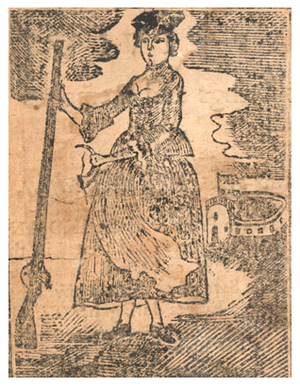 | |
| Mary Rowlandson, Wikimedia Commons. |
But Rowlandson's narrative has some troubling complexities to it, despite this seemingly black and white tautology. In particular, the infant of one of her captors dies of some illness, and Rowlandson's narrative comment is that, once the infant died, there was now more room for her to sleep in the wigwam. I found this comment so surprising, as a foundational Christian/Puritan value seems to focus on the love of God for all human beings, and seems to particularly value the innocence of childhood and infant life. Yet, Rowlandson, who can scarcely go a page without quoting from the Bible, has no compassion or pity for an infant who dies, evaluating it purely in terms of utility -- now that the infant is dead, there will be more room for her to sleep in her captors' wigwam. True, it's the child of her enemy--but it's a child that's died, nevertheless.
On the one hand, you could read this as typical eighteenth century colonial racism, a simple manifestation of the aboriginal person's subhuman status in the eyes of European settlers. Indians are inferior or less than human, so the death of an Indian baby really doesn't matter to her as much as the death of a European baby would. But I don't think it's that simple. I'd love to consider this comment alongside another comment she makes towards the end of the narrative, as she reflects on things she ate during her captivity that she previously would have found disgusting, such as bear meat: "I cannot but think what a wolvish appetite persons have in a starving condition." She can't believe how her longheld ideas about what constitutes "acceptable" food change once she is removed from her social environment. Whether she means to or not, Rowlandson creates some space here for doubting the fixity of deeply held beliefs. Just as food that would have made her shudder becomes delicious to her once she doesn't know where her next meal is coming from, perhaps her Christian values about love, charity, and the value of life take a back seat to pure survival instincts.

No comments:
Post a Comment